
PRESS RELEASE
Ruth Thorne-Thomsen
Apr 14 – Jun 6, 2026
Gitterman Gallery is proud to present an exhibition of vintage gelatin silver prints by Ruth Thorne-Thomsen, opening Tuesday, April 14th and continuing through Saturday, June 6th.
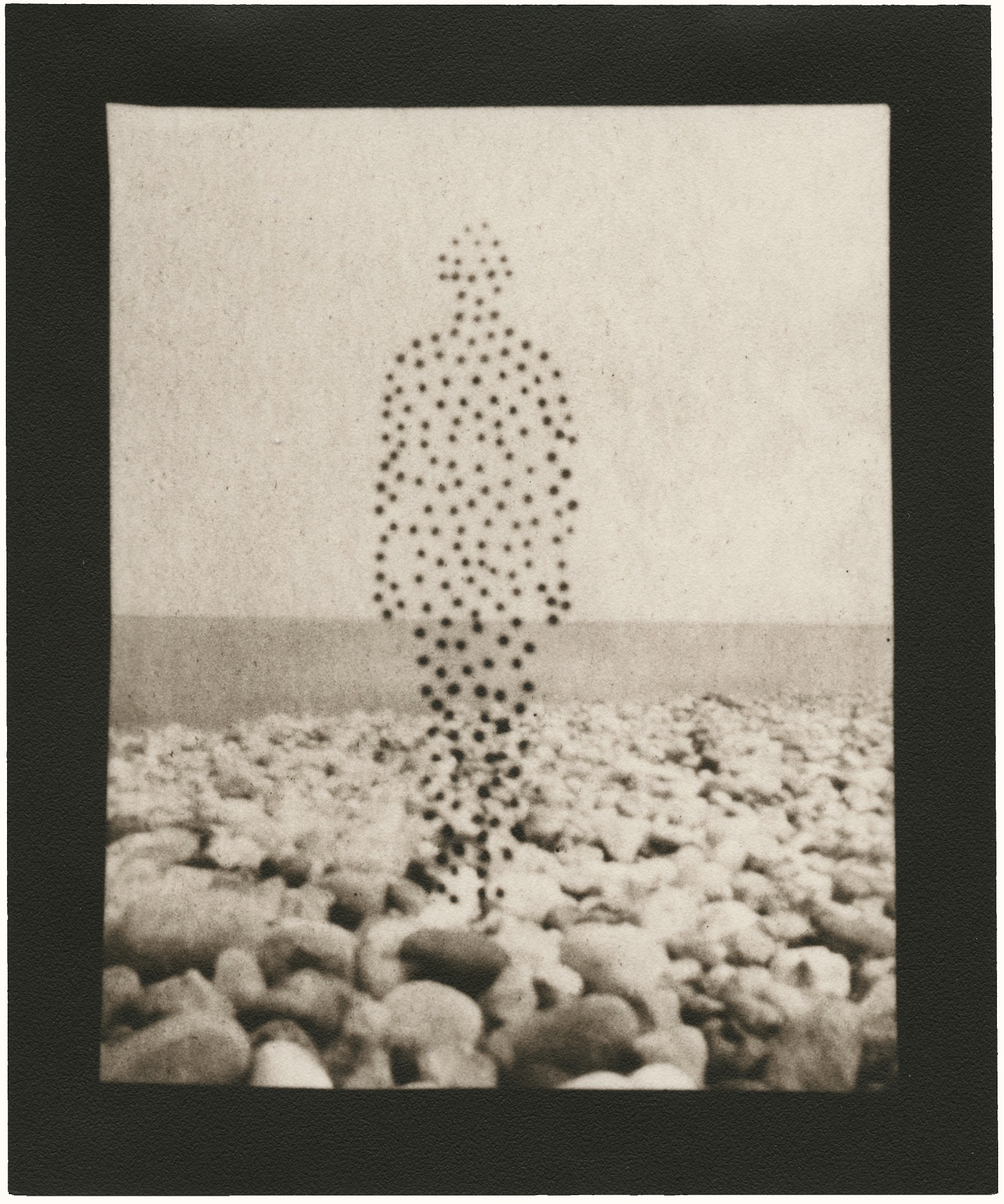
Ruth Thorne-Thomsen’s imaginative images provide a sense of wonder and reflection. Thorne-Thomsen staged photographic images within a landscape and then photographed them to create seamless surreal scenes that often alluded to mythology and history. They seem to offer evidence to dreams and provide a deeper understanding of our psychology.
I create visual metaphors for experiential states through images from multiple sources, using photography to create the unity of a visual field that is the illusion of reality. Some see this effect as a contradiction of the medium’s ability to create a sense of actuality; in fact, it is this very contradiction that excites me. As an artist I explore internal and meditative states of mind arising from the fabric of my personal experience. I use images that attract me and arrange them and photograph them through a pinhole aperture. This sometimes playful approach allows me to create imaginary realms that suggest, rather than describe, paradoxical states. While my images derive from personal choices they aim at evoking universal experiences. My working process changes with the needs of the work. — Ruth Thorne-Thomsen
Born in 1943 in New York City, Thorne-Thomsen grew up in Berkeley, California until she was twelve when the family of five children moved to Lake Forest, Illinois. She studied dance from 1961-63 at Columbia College, Columbia, Missouri, and then from 1966-1970 she pursued a B.F.A. in painting at Southern Illinois University in Carbondale. She earned a second B.F.A. in photography from Columbia College Chicago and then an M.F.A. from the School of the Art Institute of Chicago in 1976. She taught at Columbia College Chicago from 1977-83 and later at the University of Colorado Denver.
Thorne-Thomsen’s interest in photography came from her mother and her grandmother who were both amateur photographers. However, it was after the tragic death of her younger brother, Carl, who was killed while serving in the Army in Vietnam in 1967, that she became more engaged with the medium. She repeatedly printed negatives in which he was portrayed and learned while grieving. Later, in the early 1970s, she brought a camera with her for a summer in Alaska and felt a connection to exploration photographery. She got her first pinhole camera from a friend in grad school and later began to experiment creating dioramas in the sand and photographing them with paper negatives. Though she later transitioned to a Graflex camera and to 4x5 negatives, she created a similar pinhole aperture for her lens to maintain the seamless transition from her photographic constructions to the landscapes in which they were placed.
Thorne-Thomsen was well read and interested in mythology and dreams at a young age through the influence of her grandmother. She even worked with a Jungian analyst for a brief period in 1982 to better incorporate symbolism into her work. Her continual use of the head as a visual metaphor suggests that we explore the individual psyche. By using familiar iconography, motifs, and symbols, she implies that there have been truths that have been a part of humanity since early times, and we are therefore part of a collective existence.
This exhibition is a selection of work from several series:
Expeditions (1976-1984) alludes to 19th century photographs of Egypt and recapture a sense of wonder of seeing monumental ruins of early civilizations. Thorne-Thomsen toned much of this work to echo salt prints and albumen prints from that period.
Door (1981-83) engages in the symbolism of water and rocks, and many were made in Door County, Wisconsin, where her family had a home. After her 1983 trip to the islands of Greece, such symbolism continued in her work.
Views from the Shoreline (1986-1987) references 15th century Florentine profile paintings by Piero della Francesca and his compression of space between the portrait and the landscape behind. Yet Thorne-Thomsen uses that familiar construction to create images that evoke a surrealist landscape of the unconscious juxtaposed with the land, not the land owned by the figure but rather a symbol of earth and the continuum of time.
Songs of the Sea (1991-1993) was made in Wisconsin but alludes to Greek mythology, continuing her interest in nature and the symbolism of water. Just as with mythology itself, these works are part narrative and part psychological exploration.
Proverbs (1997) takes Songs of the Sea a step further, adding provocative titles to imagery of classical figures poised in a performative or theatrical manner.
Dot People (2000) depict figures that seem to be made of rocks woven together in almost a constellation. They expand upon an idea from an early piece from Door titled Dot-Lady and elements from Prima Materia (1985-87), the first matter, which, aligned with the concept of Gaia, promotes the unity between humanity and nature.
Ruth Thorne-Thomsen died on October 27, 2025, at the age of 82. She was married to photographer Ray Metzker (1931-2014), who she met while teaching in Chicago in the late 1970s, and they lived in Philadelphia. Though her work is in museum collections, including the Metropolitan Museum of Art, the Whitney Museum of Art, and the Centre Pompidou, and she had exhibitions with significant galleries, her work deserves greater recognition. Gitterman Gallery is proud to be working with Daniel Cooney Fine Art, Santa Fe, in representing the Ruth Thorne-Thomsen Archive.