ARTFORUM
May 2, 2026 - Donald Kuspit
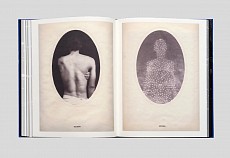
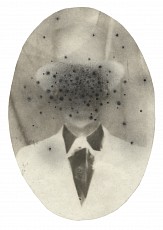
There’s something perversely nostalgic about Dan Estabrook’s faux-vintage photographs, eighteen of which appeared in “Forever & Never,” the artist’s solo exhibition at Gitterman Gallery. In The Clown, 2012, we saw the silhouette of a top-hatted gentleman. In the middle of his face is an elongated red trapezoid, highlighting his nose. The detail, ostensibly meant to read as a bit of circus makeup, instead calls to mind a warning label from an antique bottle of poison. In Little Devils no. 8, 2002, a sort of companion piece, we saw the same presumably nineteenth-century figure, this time solarized. His visage is adumbrated by sprinklings of black, resembling mold spots or traces of spilled gunpowder. A comparison was being set up with these two works: between dark and light, perhaps, or between good and evil. Yet each one exudes a similar air of decrepitude and ruination, as if both were culled from adjacent corners of a particularly abject hell. In the salt print Untitled, 2001, a glowing egg-shaped object numinously rose out of a magician’s hat that rested on a table. A theater of the absurd is being presented here: The pure-white oval hovers over the chapeau’s stage like brim as if it’s about to pirouette. The luminous flattened form—purely abstract—provides a stark contrast against the silken cap and the ornately brocaded fabric hanging in the picture’s background. Utilizing obsolete photographic processing techniques (such as gum bichromate and calotype), the artist constructs tableaux that are at once contemporary and utterly traditional.
As the title of this show implied, Estabrook sets up a series of contradictions—or, more pointedly, subtly ironic doublings and incongruities, as demonstrated in Breath, 2004, which depicts a positive and negative image of a young woman in profile. Exhaling clouds of ornamental line work, she invites us to question whether the photograph is abstract or realistic—an aesthetic construction or a matter-of-fact representation. Interior (Gloves), 1995, featured the titular garments, white and opera length, worn by somebody engulfed by a sea of blackness. This piece seems to dismiss the (living) subject into oblivion—the work is not a memento mori, but a souvenir from some kind of permanent purgatory. An albumen print, Interior (Playroom), 1995, was an oval composition that presented a somewhat modern-looking chair with a large white ball on the seat, both of which are positioned at an angle toward a white wall with painted black stripes. Another ball, also striped, sits on the floor opposite the chair. To my mind, the scene evinces a formalist (and mockingly Minimalist) sensibility. A similar brand of ironic Minimalism was evident in Double Mirror, 2018/2026, a shot of two looking glasses—one circular, one rectangular—that reflect nothing. I could not help but perceive them as canvases, nihilistically blank.
Estabrook is clearly interested in unresolvable contrasts and paradoxes. While virtually all of his enigmatic photographs appear cool and calculated, his Victorian-style aesthetic gives them a sentimental warmth. Indeed, the artist’s experimental bravado is tempered by this patina of yesteryear, which mischievously quotes the past to comment on the present.
LINK